Friday, August 7, 2009

Daily Audio Blog.

Daily Audio Blog.

A new feature!
My posting throughout the life of this blog has been carefully considered and written essays, but that really doesn't get updated often. So! I want to start this new feature, called Daily Audio Blog. (or at least until I come up with a better name for it.) Every day, or as often as I can, I'll post a 30 second audio clip of some place I've passed through during those 24 hours. Outside, inside, kitchen, party, whatever. I'll also post a photo from the place I took the sound. So it's an audio-visual portrait, hopefully one that's vague enough to dredge up some free association without a specific narrative.

The first picture can be seen above, from the porch off of my current apartment in Somerville, MA.

Without further ado, 30 seconds of today:

Thursday, August 6, 2009

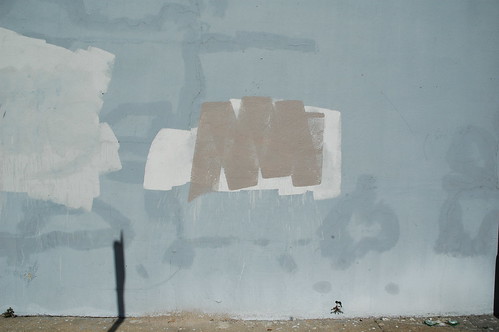
Street Rothkos.

Street Rothkos.
Via Hrag Vartanian: http://bit.ly/3HhbwB

These photos are accumulations of paint, either from construction or buffing (covering over) graffiti, that have taken on the delicacy and color layering of Rothko paintings. They also bring to mind a handful of other abstract expressionists and action painters, Clifford Still, Cy Twombly at times.

The colors are obviously beautiful on these, the light of the street combined with the flat colors of paint mix to something transcendent. The shapes of the paint strokes too have this kind of vernacular poetry that might not have been intentional, but comes out with a kind of energy and directness that's rare even in the work of talented artists.

Here's my own contribution, from Beijing:


I walked by that almost daily for the three weeks I was there last, and the sheer immediacy of the paint was pretty shocking. There are these six stripes on the wall, obviously covering up some lines of writing, but they're placed in such a way that they control this entire stretch of blank white wall. The drips and splatters are classic action/abstract expressionist and the red top and bottom sections remind me of Barnett Newman. Cool stuff. Compare to Vir Heroicus Sublimis, the great MoMA Newman masterpiece:


via Artnet

It also reminds me of the Japanese action painting movement Gutai. A lot of their work was based on gesture: bursting through a sheet of paper, using hands, feet, heads to move paint around on canvas.


Sunday, May 17, 2009

Dana Schutz and Itchy Life.

Contemporary Evidence.
Dana Schutz Missing Pictures at Zach Feuer Gallery


Dana Schutz recently had an exhibition of new paintings at Zach Feuer gallery. It was much buzzed about, notable being the freshness of the work and its instant-classic art history dialogue making. The paintings to me are phenomenal; they bring together a history of figuration in art, a destructive surrealism and a constructive belief in the representative power of real life. Even though her figures fall apart, they get built back together into archetypes and put onto theater stages to totter in our gaze.

Painting a figure is a loaded gesture. It’s a kind of visual snap to the viewer, the lines click together into the shape of a person and it immediately carries a connotation: these lines are a body. What is the body doing? What is performing? What do its actions mean to us? Painting a figure refers compulsively to now. Representing a person is representing the present tense; it carries information about how we think of ourselves within our environment. That’s what makes Dana Schutz’ paintings so interesting: despite depicting events that could take place within some altered universe out of time, they come back relentlessly to now and the evidence and detritus of our lives.


Like the politics of Dada and Surrealism’s origins in the enervation and desperation of World War I, Schutz’ paintings distill the contradictions of life around them. The same visual trauma that is evident in Max Ernst’s melting landscape The Eye of Silence (1943-44) and Yves Tanguy’s Indefinite Divisibility comes through in Schutz’ 2008 Accident. Like a splinter lodged under the skin, the present irritant pushes through to the surface of the painting and makes itself felt in scars and striations. The tar of pavement becomes a series of writhing lines topped by wrinkled material, cloth or metal or an abstract quantity, bordering an eye-obstructing black hole. What’s the irritant here? What makes the ground so twitchy and hypersensitive? Something like the itch of what’s happening and the grating need to make it into art. I think that’s part of the urgency of Dana Schutz’ paintings. The irritation, then the painting, is the physical evidence of how we live.


Max Ernst, The Eye of Silence, 1943-44

So what is it to live in Dana Schutz’ mirror?

People are distorted into half forms, with dangling arms and burnt away sides. A blind masseuse’s eyes gape glowing into the air, neck thrown back and teeth bared. He grasps his subject’s foot with fingers that tangle into each other and turn into lines in front of us. Everything confused and pictorial space mushed up to the front, the painting becomes a wash of beautiful colors that pulse with the hues of rashes and bruises. It’s a fleshy story. Two chess players sit at a table; a normal scene except the players burn into leftover halves, a leg crumbles and a park planter turns into a bed of splotchy germs. The funny thing is that the picture retains its normalcy. What’s wrong with this alternate universe? Throughout it all the chess turn-clock keeps ticking into the middle, untouched. A woman gapes at a newspaper, but the woman’s face suddenly turns into Goya’s Saturn Devours His Son.


Goya, Saturn Devours His Son, 1819

Nothing is settled in these paintings. It all keeps pushing against each other in a constant battle to stay, to draw attention, to live for the audience. There’s a sense that the pictures are using themselves up in a constant mytosis of form, breeding and dying in front of our eyes. Atop all this, certain touchstones stay whole. A pair of glasses. The movie title Spiderman 3 scrawled into the sand. What remains are the things we recognize. The RCA dog listening to a gramophone. The sudden recognition of pop symbols is present and anxious. Schutz’ paintings don’t want to stay abstractly beautiful. They fight to form things, not deconstruct them. The figures fight to stay in focus in the blistering of life rushing past.


It’s an itch to stay alive. It’s a constant itch not to dissolve into a pile of thoughts, a pile of misguided and misdirected instincts and emotions.


Dana Schutz’ figures are victims and witnesses. They watch as they crumble and blow away and topple, only to pile up again, a squirming stack of lines that snap back into people and eyes. Like late Guston’s despairing Klansmen and clutching hands, the pictures seem so intent on being that meaning becomes less important than existing. Life is a struggle not to fall apart. That is what makes Schutz’ paintings so local but universalized in time; they are always fighting to stay in the moment you see them. That’s what makes me itch.

All pictures not noted are by Dana Schutz, a log of Schutz' gallery shows and titles can be found here. Schutz is represented by the Zach Feuer Gallery.

Saturday, March 14, 2009

Shepard Fairey and Tufts University

Appropriating appropriation and its consequences.


Shepard Fairey is an artist who has been pretty in the moment recently. From an early mid-career retrospective at the Boston Institute for Contemporary Art to his omnipresent portrait of Barack Obama that became a rallying symbol for the president’s campaign to his scandal-inducing wheatpastes on Boston-area buildings, Fairey has been in the news for months.

This isn’t about Fairey’s mind-numbingly stupid arrest in front of the ICA before the opening of his show though. It’s not about the court cases he has had to endure for doing some illegitimate wheatpasting in Boston on his own time. This is just about one Fairey piece in particular, a mural put up outside of the Tufts campus center on January 25, 2009.

As an adjunct to his show at the ICA, Fairey was commissioned to put up about a dozen murals around Boston. These were large, wheatpasted pieces consisting of the artist’s iconic black, red and white designs, pre-printed, aligned and then stuck on the wall. One can’t blame the ICA and independent curator Pedro Alonzo for trying to take it to the streets a little, that’s one way to give a museum exhibition of street art some life. Despite the museum’s good intentions, however, it’s sometimes hard to avoid provoking someone in artistically-conservative Beantown.


The important thing to remember is that the owners, or managers, of the places these murals were installed in agreed to have them. In a sense, they agreed to play host to Fairey’s art of appropriation and accept the work’s parasitic relationship with its location. Shepard Fairey’s work depends on its environment, and it has a direct influence on it: namely, Fairey’s work politicizes space, and does it well.


This brings us to the case of Tufts University’s Fairey mural. First, the true and whole story of the mural’s short, sharp existence. Sherman Teichman, the head of Tufts’ Institute for Global Leadership, is a personal friend of the director of the Institute for Contemporary Art, Jill Medvedow. This led Teichman to be aware of the ICA’s scouting possible locations for Fairey’s murals. Teichman jumped at the chance, getting the installation of a mural at Tufts approved in a shotgun meeting of university officials. January 25 saw Shepard Fairey brought to campus along with curator Pedro Alonzo and the artist’s crew of assistants.

Hours later, the finished mural was up, a combination of an assertive Asian-looking woman wrapped in a head scarf, a giant black and white peace-sign hand and an assemblage of smaller posters. What the wall also held is a politicized space. Shepard Fairey opened the wall, appropriating the neutral space of Tufts University for his own message, a message that is still a markedly political statement, though it is ostensibly for peace.


Something that has been appropriated once, and so visibly in this case, tends to never quite be pure again after. This is important. It’s an innate aspect of modern and contemporary art. Think of Marilyn Monroe. Is it possible not to see Andy Warhol’s garish screenprints? An imposed meaning tends to overwhelm a neutral base. What was once a blank wall became, after Fairey’s mural, a space for self-expression. And it was used as such.


Milan Kohout is a performance artist from the Czech Republic. He currently teaches a class on performance art through Tufts University’s Experimental College. The class is a mix of discussion and practice, rehearsal and performance. During one class he suggested to his students how interesting it would be if Shepard’s violated space, the wall and the mural, were to be added to. What effect, he asked, would another layer of meaning give to this piece? Another physical layer of posters, combined with another conceptual layer of symbolism? Some of Kohout’s students took that question to heart. They added their own political posters to the politicized space of the wall, politicized space that was directly approved by the highest levels of Tufts University administration.

The new posters caused some controversy. The students’ work confronted some highly charged issues, including Roe v. Wade, the endless optimism of Obama’s followers, and gay marriage rights. Immediately the posters provoked a negative response that Fairey’s work failed to. Tufts Unversity’s anti-bias group BEAT as well as the LGBT center took issue with the posters’ up-front politics and what they deemed as excessive imagery. The posters, along with the remains of Fairey’s mural, were torn down, under the blessing of Tufts’ Dean of Student Affairs Bruce Reitman. The new posters were rejected by the same staff that approved Fairey’s original mural.


My point is that, in terms of art in relation to politics, the two waves of appropriation of this blank wall were equally political and equally valid. And yet Tufts’ administration chooses only to approve of the first. These second posters were nothing if not an expression of free speech, a piece of performed art, where the first mural by Shepard Fairey was a gesture more motivated by personal branding than real communication. Which does Tufts bestow its approval on?
There is an inherent paradox in complaining that a space that has already been appropriated for art is appropriated once again by the students of this university. Tufts’ actions towards the posters betray its fundamentally conservative view towards the visual arts, one that the university has done nothing to correct and everything to reinforce in its treatment of Fairey’s mural and the subsequent posters.


______________________________________
Notes:
All photos courtesy of myself besides the last two of the posters, courtesy of Meredith Klein and the Tufts Daily

Shepard Fairey is the figure wearing the puffy coat and gloves in the photos.

For further information:
See this Daily article on the added posters: here
See this article describing the original mural: here
See this post on the Boston Globe's Exhibitionist blog: here
-in particular, please note this quote: "Apparently, an adjunct faculty member at Tufts University advised his students to ruin the work Fairey had been asked to create" [emphasis added]

If you are interested in more information about Fairey's mural at Tufts, please stay tuned.


Friday, February 20, 2009

Medium Beijing.

Medium Beijing.


I just got my medium format film that I shot in Beijing developed, here are my highlights. Sadly, the camera case got in the way in a few shots... that's why you see the dark area on the bottom edge. I'll know better next time! See Yugong Lama Temple, my dorm room, Wangfujing, the road outside of Xizhimen and a tourist junk shop.


Tuesday, January 6, 2009

Mark Rothko's Garage.

Mark Rothko’s Garage
There’s a picture somewhere that shows an aging Mark Rothko, maybe somewhere around 50, sitting in his garage on a metallic chair, a brush in one hand and a painting in progress tilted in the other. Against the backdrop of shelves of junk and cluttered walls, he scrutinizes the painting he’s holding. The canvas is stained a deep blood red, and the outlines of a central lighter colored rectangle are just coming into focus.


The first time I saw the photo it stuck in my head for no good reason; only after a while did I realize what was bothering me about it. Mark Rothko was a painter of the ineffable, an artist that reached for a point in the infinite distance, his work attempting to find a pathway to spiritual utopia. He was proud of the fact that his paintings caused viewers to start weeping in museums.

So what was he doing painting in a garage?

Rothko, sitting in his garage, surrounded by the grey detritus of everyday life, looking suburban. And yet the painting he holds in his hand, roughly, by the canvas stretchers, is supposed to be a gateway to a plane above the human milieu, infinite calm. It doesn’t seem fair. It doesn’t seem right that this perfect object should be made by someone sitting on a rusty chair gazing critically at the thing like it was a disobedient dog. Don’t paintings like this get excreted unbidden from the walls of MoMA, pre-canonized? Mark Rothko in his garage. It was just too messy.


This is a problem about the innate humanity of art, the grit versus the glossy sheen that gets slopped on by the pedestal of modernism, the aura of a lot of money and the white box chapels that we keep our art in. Where do the dirty hands of the artist meet the finished product, prepped for viewers and critics and onlookers? Where are the blood and guts?

Art has to get made. The unexplainable, the floating-in-the-air, has to get processed down by some enormous act of will, fueled by pressure and insecurity and fallibility, into a thing that, in Rothko’s case, has the look of the infallible. No umbilical cord left, no blood and mucus-spattered squalling infant. Where do we make the jump from something made in someone’s sun-baked, dusty garage to the infinitely clean pinnacle of modernism that Rothko’s paintings make on a white wall? The artist was fond of calling his ethereal paintings “facades”; the term seems most appropriate describing this dichotomy of process and product.


Maybe gazing at the surface of a Mark Rothko painting for long enough will elevate you to the kind of spiritual state the artist had in mind. But then there’s the back side, the artist sitting in his garage. I tend to think that the garage is just as important for a viewer to see as the surface. Unfortunately, most museums don’t make it easy. The work looks resolved on the walls, set up into some unknowable cosmic order.


Every painting in MoMA’s modern galleries is a lady on the street but a freak between the sheets. Gauguin died of syphilis in Tahiti after leaving his wife and children and desk job in Europe for the myriad freedoms of more “primitive” nations. Mark Rothko died in a pool of his own blood slumped over his kitchen sink after he slit his wrists at the elbows, unable to sustain his pursuit of the ineffable. So much for infallibility. Jackson Pollock and Willem de Kooning were alcoholics. We all know van Gogh cut his ear off and sent it to a prostitute and Picasso had mistresses till he died in his 90s. All this begs the question, how can these artists’ work possibly look pure and resolved when it’s on the walls? How does so much life end up dry? Dig a little bit and there’s always a garage that’s worth looking for. The pile of stuff in the background, the psychic detritus that art distills, is what makes the end result interesting. Go into a museum and look for the blood and the guts and the conflicts, because the infallible surface is never all there is.


*all pictures here are Rothko paintings culled from various sources on the internet, their titles aren't very descriptive, and I think looking should be enough anyway.